
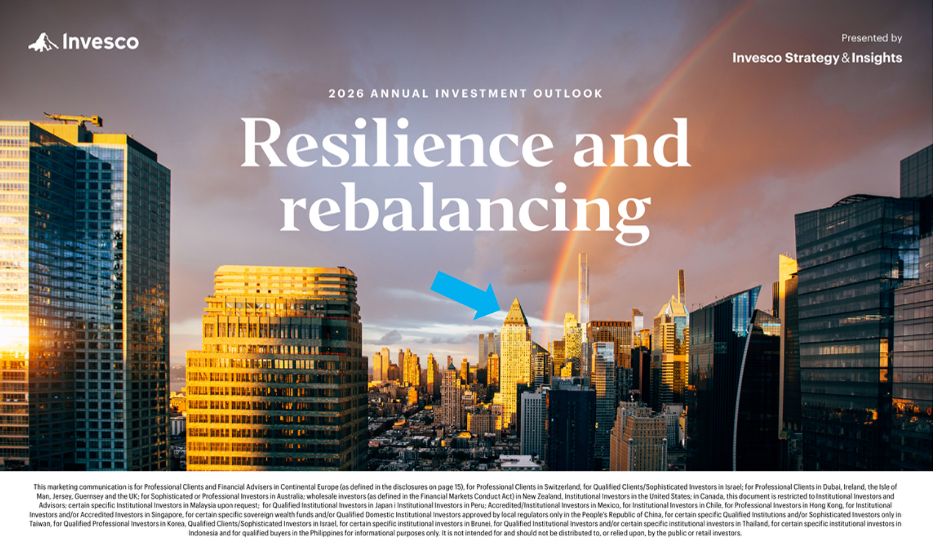
Jon Gray used this building to explain the EOP acquisition. It’s down 80%. What does that say about the real estate outlook?
If Worldwide Plaza is the pot of gold at the end of the rainbow...
Couldn't help but to notice that Worldwide Plaza happens to be at the end of the rainbow on the cover of Invesco's annual outlook.
[The report is primarily about global shifts, stocks vs. bonds vs. alts (credit and crypto). No mention of real estate equity but favorable talk about real estate credit.]
A more pressing question for the real estate industry:
With Worldwide Plaza's value down 80% since 2017, is this a generational buying opportunity or a perpetual erosion of value?
Arguments for each side:
---- Glass half full ----
Properties tend to trend with replacement cost across cycles.
Over the last 30 years, WWP has gone from $375M in 1996 to $1.7B in 2007 to $600M in 2009 back to $1.7B in 2017 and now back down to sub $400M.
Volatile? Yes.
...but value has trended around replacement cost.
---- Glass half empty ----
This time is different. It and old buildings like it will not recover this time.
PS -- Interesting fact: Jon Gray's conviction in buying EOP was anchored in his belief that values anchor around replacement cost across cycles, and he used this building as the poster child for that conviction when talking with investors, which worked out very well for Blackstone 20 years ago. Back to the replacement cost playbook?
If Worldwide Plaza is the pot of gold at the end of the rainbow...
Couldn't help but to notice that Worldwide Plaza happens to be at the end of the rainbow on the cover of Invesco's annual outlook.
[The report is primarily about global shifts, stocks vs. bonds vs. alts (credit and crypto). No mention of real estate equity but favorable talk about real estate credit.]
A more pressing question for the real estate industry:
With Worldwide Plaza's value down 80% since 2017, is this a generational buying opportunity or a perpetual erosion of value?
Arguments for each side:
---- Glass half full ----
Properties tend to trend with replacement cost across cycles.
Over the last 30 years, WWP has gone from $375M in 1996 to $1.7B in 2007 to $600M in 2009 back to $1.7B in 2017 and now back down to sub $400M.
Volatile? Yes.
...but value has trended around replacement cost.
---- Glass half empty ----
This time is different. It and old buildings like it will not recover this time.
PS -- Interesting fact: Jon Gray's conviction in buying EOP was anchored in his belief that values anchor around replacement cost across cycles, and he used this building as the poster child for that conviction when talking with investors, which worked out very well for Blackstone 20 years ago. Back to the replacement cost playbook?
COMMENTS