
For decades, the real estate investment management playbook was pretty straightforward:
1. Raise long-duration pension capital
2. Launch a core fund
3. Get into NCREIF’s ODCE index
4. Stay close to the herd
5. Watch profits scale once AUM clears $3-5B
The defining mantras of that era:
-- Allocation > operation
-- Real estate is an inflation hedge
-- Diversification = more return per unit of risk
-- 1%+ fees on a base that grows with inflation
-- Everyone wins
But someone forgot to tell buy-and-hold investors to stay the course.
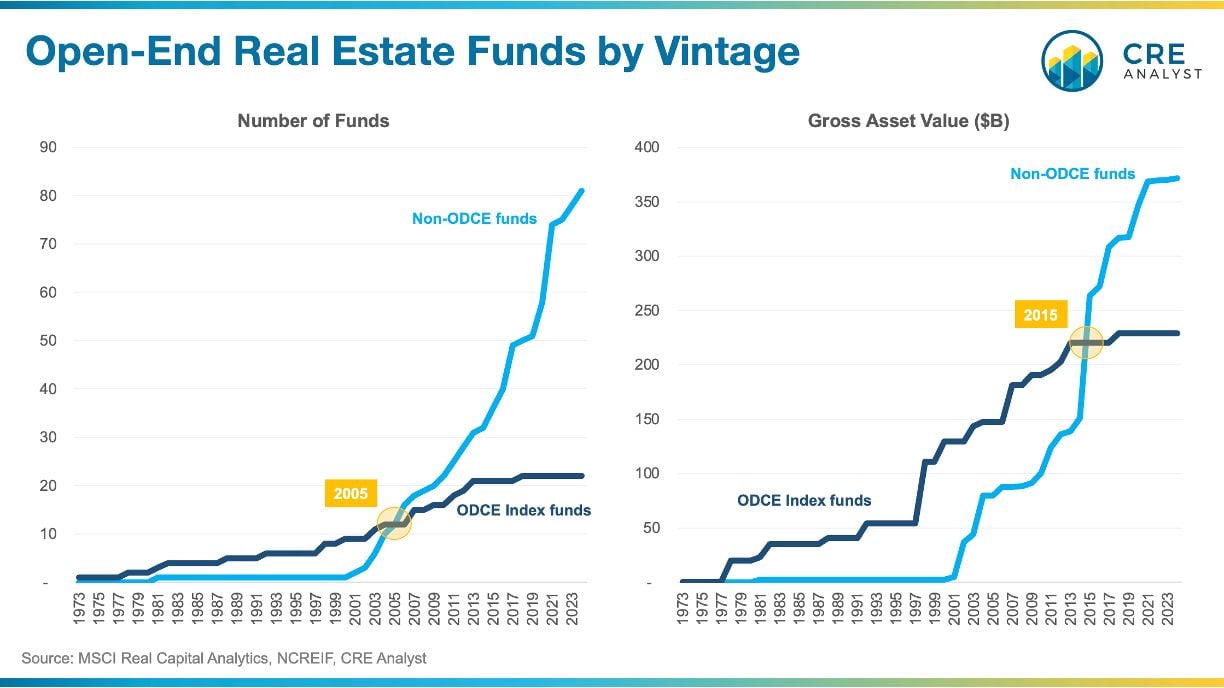
Breaking down today’s open-end funds by the year they were launched suggests that a different model quietly emerged after the GFC.
By 2005, the number of non-ODCE funds had already eclipsed the number of funds in the index. And by 2015, the value of non-ODCE vehicles surpassed the ODCE’s collective NAV.
Since then, the ODCE has been effectively flat, while non-ODCE vehicles have exploded in both scale and influence.
The firms defining this shift:
-- Blackstone (BioMed, BPP, BREIT)
-- Clarion (Lion Industrial Trust, Gables)
-- Prologis (Targeted U.S. Logistics Fund)
-- Harrison Street (Core Property Fund)
-- Ares (Industrial Real Estate Fund)
-- Kayne Anderson (Core Real Estate Fund)
-- Invesco (U.S. Income Fund)
-- Greystar (Growth & Income Fund)
-- Nuveen (U.S. Cities Industrial Fund)
The new mantras look very different:
-- Specific sector bets (especially industrial)
-- Expanding into alternatives (Harrison Street, Kayne)
-- Reaching for yield in a low-rate world (Invesco, Carlyle)
-- Betting on operators (Prologis, Invesco)
Key takeaway:
Redemption queues get all the attention, but a lack of creativity may be the real problem.
PS -- Like it or not, real estate follows the capital. Want to better understand how capital moves through the real estate system? DM us to explore joining our upcoming FastTrack cohort.
---- Note on a new data source ----
Our little team consumes a lot of real estate information. And candidly, most of it repetitive and not very insightful, which makes it exciting when we stumble on something special.
A few months ago MSCI added fund information to its data portals. Very different than its popular comp sets and standardized data downloads. And as shown in these charts, we've found it to be a uniquely powerful tool for spotting trends and differentiating winners and losers.
Might want to check out MSCI if this sort of analysis interests you.
(Reminder: no paid endorsements, just highlighting a good resource.)
COMMENTS