
Stop trying to out Blackstone Blackstone.
Play a game you can win.
In the last 3-4 weeks, Blackstone:
-- Launched a unified AI investing platform (BXN1)
-- Took BXDC public in the largest pure-play data center REIT IPO ever
-- Launched a $5B JV with Google
The BXDC raise is telling. How many other managers could launch an externally managed, blind-pool REIT with zero seeded assets?
They pulled $1.75B and the stock gained so much that a leading researcher changed its recommendation from buy to hold in four days.
Bottom line on BXDC: investors bought the brand and the pipeline, not a portfolio.
Bottom line on Blackstone: the firm clearly has a genuine edge.
So what's the actual moat? Ask around, and you get the usual answers.
-- Favored nation. Nobody gets fired for picking Blackstone.
-- Flexible capital. Dry powder across the whole risk spectrum.
-- Unique insight. 250+ portfolio companies feeding the read.
-- Talent. Harder to get hired there than to get into Harvard.
All true, but no real monopoly.
---- The Real Moat ----
Blackstone is uniquely willing and able to make big f'ing bets.
That's it.
That's their moat.
The structure is the point. Most managers sit inside a bank, an insurer, or a REIT, governed by risk limits, EPS targets, and committees.
Those constraints are features, not bugs. LPs are often paying for exactly that discipline. But they make a Blackstone-like bet structurally impossible.
---- The "Messy Middle" Myth ----
Here's the actionable part...
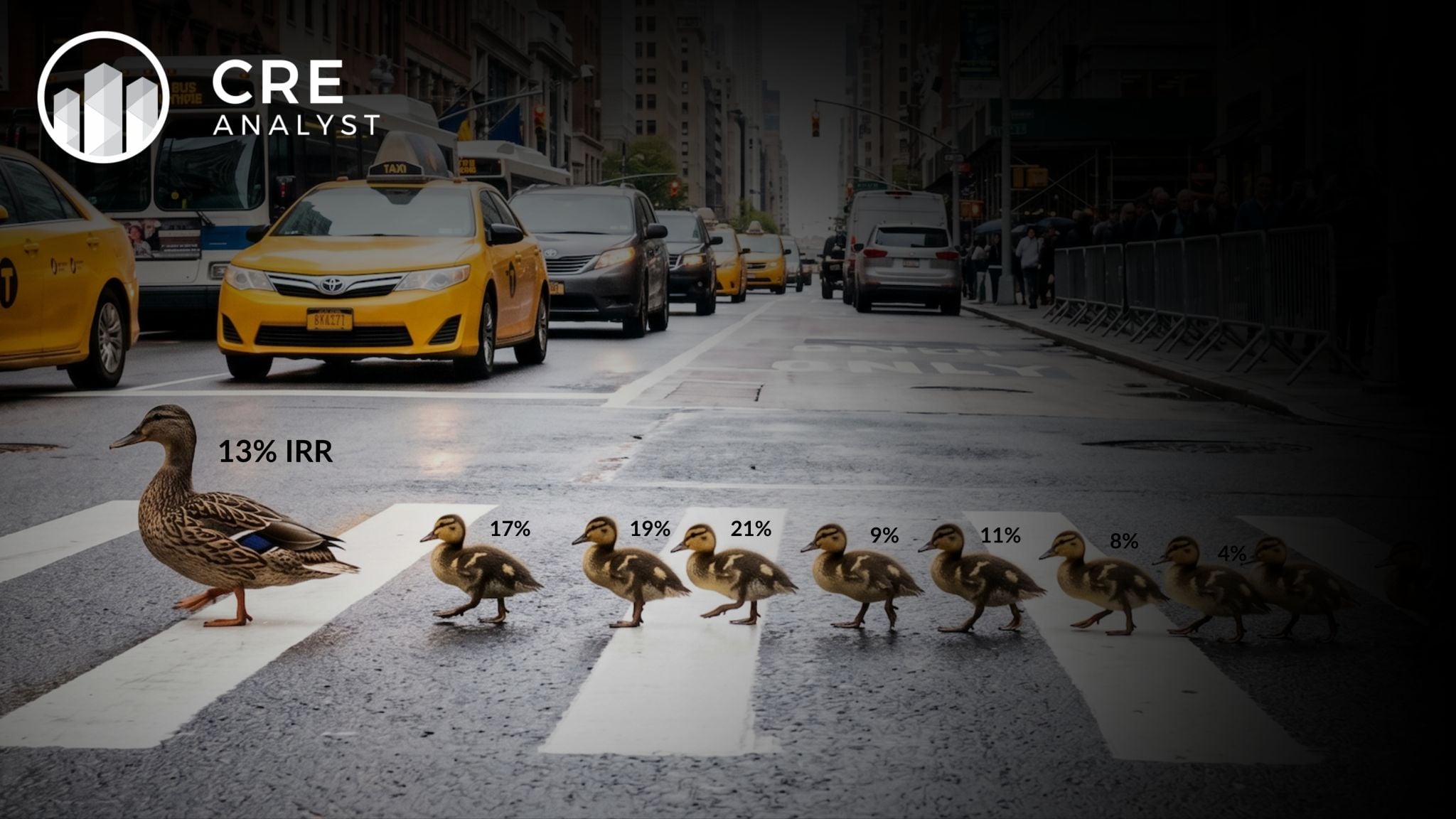
The convenient story: everyone who isn't Blackstone is stranded in a shrinking middle. Too small to compete on scale, too generic to compete on focus.
Tidy. But also not true.
Blackstone's opportunistic real estate funds have returned ~13% IRRs over the last 30+ years. Impressive at scale, but not a number that blows away the field.
Our most recent Substack article highlights a few "messy middle" platforms that have been raising meaningful funds lately by leveraging their strengths.
These are observations, not compliments or endorsements; we haven't coordinated with the firms and don't offer investment advice.
But spend a little time following the dollars and sifting through performance reports, and the "messy middle" narrative breaks down fast.
What Blackstone built is remarkable.
But the "have vs. have-not" story makes two mistakes:
1. It misreads the moat.
2. It promotes follow-the-leader, which is an unwinnable game.
If you run another shop, is copying Blackstone a strategy or the surest way to lose?
Play a game you can win.
In the last 3-4 weeks, Blackstone:
-- Launched a unified AI investing platform (BXN1)
-- Took BXDC public in the largest pure-play data center REIT IPO ever
-- Launched a $5B JV with Google
The BXDC raise is telling. How many other managers could launch an externally managed, blind-pool REIT with zero seeded assets?
They pulled $1.75B and the stock gained so much that a leading researcher changed its recommendation from buy to hold in four days.
Bottom line on BXDC: investors bought the brand and the pipeline, not a portfolio.
Bottom line on Blackstone: the firm clearly has a genuine edge.
So what's the actual moat? Ask around, and you get the usual answers.
-- Favored nation. Nobody gets fired for picking Blackstone.
-- Flexible capital. Dry powder across the whole risk spectrum.
-- Unique insight. 250+ portfolio companies feeding the read.
-- Talent. Harder to get hired there than to get into Harvard.
All true, but no real monopoly.
---- The Real Moat ----
Blackstone is uniquely willing and able to make big f'ing bets.
That's it.
That's their moat.
The structure is the point. Most managers sit inside a bank, an insurer, or a REIT, governed by risk limits, EPS targets, and committees.
Those constraints are features, not bugs. LPs are often paying for exactly that discipline. But they make a Blackstone-like bet structurally impossible.
---- The "Messy Middle" Myth ----
Here's the actionable part...
The convenient story: everyone who isn't Blackstone is stranded in a shrinking middle. Too small to compete on scale, too generic to compete on focus.
Tidy. But also not true.
Blackstone's opportunistic real estate funds have returned ~13% IRRs over the last 30+ years. Impressive at scale, but not a number that blows away the field.
Our most recent Substack article highlights a few "messy middle" platforms that have been raising meaningful funds lately by leveraging their strengths.
These are observations, not compliments or endorsements; we haven't coordinated with the firms and don't offer investment advice.
But spend a little time following the dollars and sifting through performance reports, and the "messy middle" narrative breaks down fast.
What Blackstone built is remarkable.
But the "have vs. have-not" story makes two mistakes:
1. It misreads the moat.
2. It promotes follow-the-leader, which is an unwinnable game.
If you run another shop, is copying Blackstone a strategy or the surest way to lose?
COMMENTS