
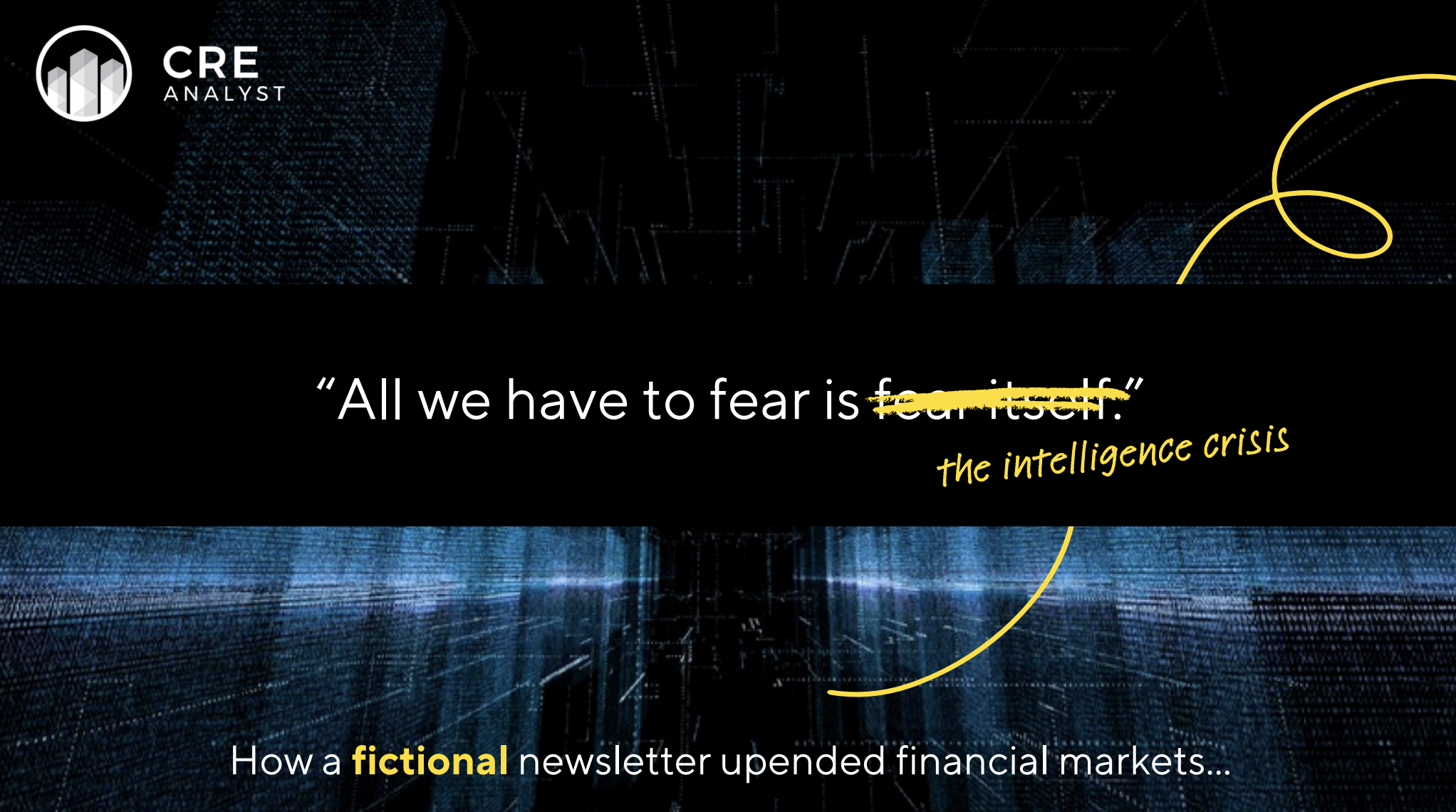
"All we have to fear is... the intelligence crisis."
The top finance newsletter on substack released a fictional dispatch from June 2028 over the weekend, which tanked the Dow by nearly 2% and sent software companies down by 10%+ and investment managers down by 4%+.
All based on fictional narrative.
----- What Citrini Said -----
Citrini Research's "The 2028 Global Intelligence Crisis" is a 5,000-word thought exercise written as a hypothetical memo from two years in the future.
The authors were explicit: "This is a scenario, not a prediction."
The scenario: AI displaces white-collar workers, corporations cancel SaaS licenses, payment networks get bypassed by AI agents, and the S&P drops 38% from its October 2026 highs on the back of 10.2% unemployment.
The report went viral with 16 million views.
----- The Fallout -----
Markets didn't care that it was fiction.
IBM fell 13%, its worst single-day drop in 25 years. DoorDash, KKR, American Express, and Blackstone each dropped more than 8%. The iShares Software ETF (IGV) hit a 52-week low, down nearly 30% year-to-date, erasing every gain since the ChatGPT launch in late 2022.
A thought exercise. Explicitly labeled as such. And yet.
----- Why Fiction Moves Markets -----
The only way pure speculation triggers an 800-point selloff is if the underlying uncertainty is already there.
Citrini didn't create the fear. It named it.
Investors have no idea AI will reshape their companies' cost structures, moats, or revenue models. Nobody does. When uncertainty is that high, a vivid fictional narrative is enough to break conviction.
Which brings us to commercial real estate.
----- What We're Doing About It -----
We can't solve AI uncertainty across the entire economy. But we can triangulate what's actually happening in our industry.
Right now, we're conducting what we believe is the first-of-its-kind benchmarking survey on AI adoption across commercial real estate. We're building a picture from the ground up that may shine light on the 4 million CRE workers.
...which functions are most exposed, where adoption is actually happening versus being blocked, and what the early movers are doing differently.
The findings will matter more than the speculation. And the only way to get them right is to hear from the people doing the work.
We'd welcome your input.
PS -- Share your perspective at the QR code in this carousel, and we'll send you the detailed results before they're publicly released.
COMMENTS