
Two acquisitions analysts at different firms can have completely different day-to-day experiences. Different deal sizes. Different comp structures. Different amounts of autonomy. Different career ceilings. The difference isn't what they do. It's who they do it for.
The type of firm you join matters as much as the function you're in. Sometimes more. Just because roles differ does not mean one is better than the other. What is important is that you know what the likely differences in roles will be and whether or not that aligns with your ambitions and where you are most likely to succeed. The best way to start wrapping your mind around this is to understand how capital flows through the commercial real estate system and where different firms sit within it. This will change how you evaluate the opportunities you encounter.
How the capital flows
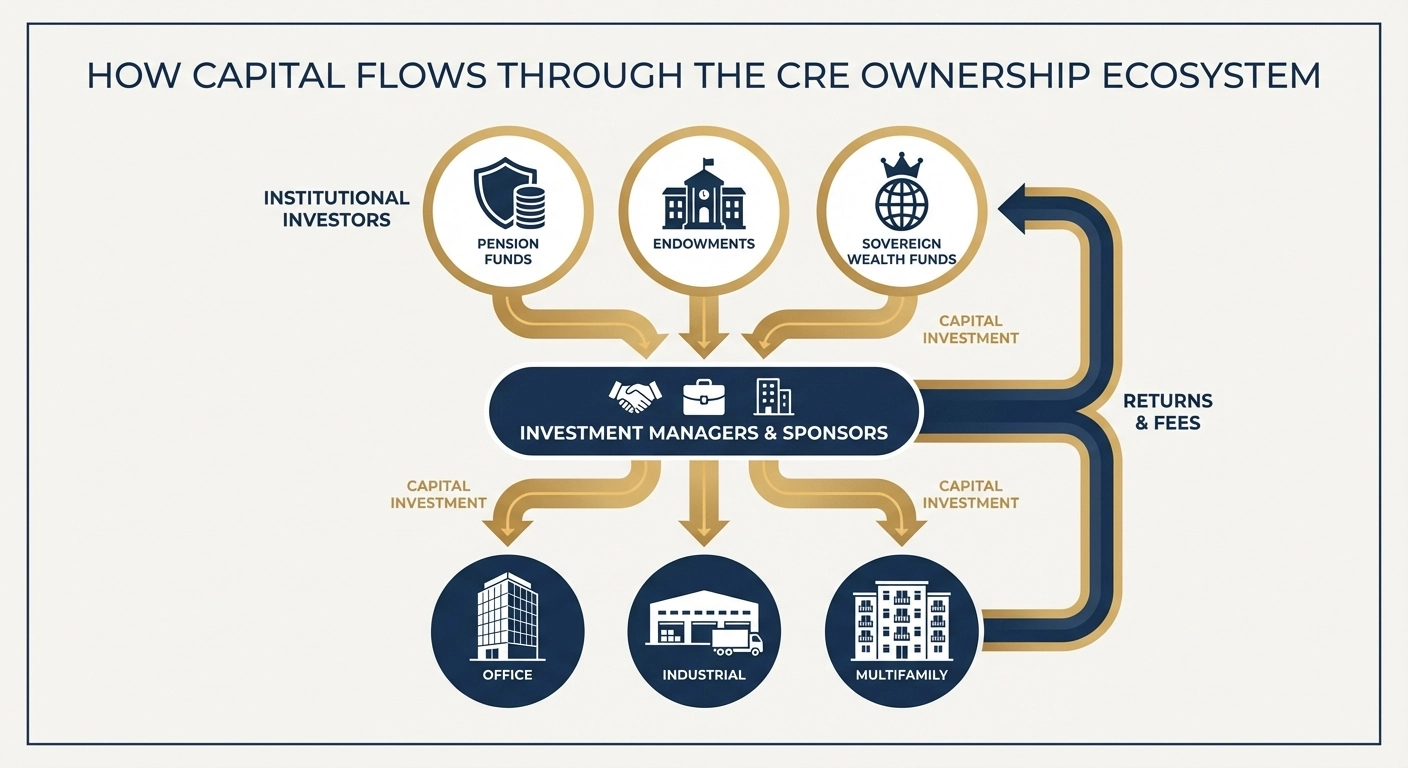
The ownership ecosystem follows a straightforward path. Generally, capital starts with investors, moves through managers who deploy it, and ends up in properties that generate returns. Those returns flow back through the system to the original investors after each party along the way collects their fees and profit shares.
The sources of capital are the large pools of money that need to be invested: pension funds, insurance companies, endowments, sovereign wealth funds, family offices, and high-net-worth individuals. These investors rarely buy properties directly. They typically allocate capital to investment managers and/or sponsors who do the work of finding, acquiring, and operating the real estate.
Where those managers sit in the ecosystem determines what your career looks like if you work for them.
The main firm types
Institutional investment managers are professional firms that charge fees to source, manage, and execute investment opportunities on behalf of outside capital. Think PGIM, Invesco, Nuveen, Clarion, UBS, or CBRE Investment Management. They manage a combination of their own capital and client capital, structured into open-ended funds, closed-end funds, and separately managed accounts. Teams are large, processes are formal, and the training infrastructure is strong. The brand opens doors for the rest of your career. The tradeoff is limited autonomy early on and compensation that follows a well-defined track.
Private equity firms raise capital focused on specific return targets, risk profiles, and investment horizons. Firms like Blackstone, Ares, KKR, and Carlyle generally use more leverage and target higher returns than institutional managers. Fund cycles typically run five to ten years with specific deployment timelines. The culture is more intense, and you'll be closer to each deal. More recently, many of these firms have launched private REIT structures to raise open-ended capital alongside their traditional fund vehicles.
REITs (real estate investment trusts) are a distinct and major category that many people overlook when evaluating ownership careers. Public REITs like Prologis, Boston Properties, and Simon Property Group trade on stock exchanges, which means quarterly earnings pressure, daily equity price volatility, and access to public capital markets. The work inside a REIT focuses on operational efficiency, dividend growth, and portfolio management with a level of transparency that private firms don't face. Private REITs have grown in popularity but remain smaller in scale.
Developers build new product. Ground-up construction and major repositioning projects with capital-intensive cycles of 18 to 48 months, sometimes longer. Developers bring deep product-type and execution expertise and typically partner with institutional investors and construction lenders to capitalize projects. Compensation includes development fees plus promotes (additional profit shares) on successful projects. The risk profile is higher than any other ownership category, but so is the potential upside.
Operators and sponsors combine operational expertise with local market knowledge to identify and execute investment opportunities. This includes regional owner-operators, family offices, and smaller entrepreneurial firms. Team sizes range from a handful of people to a few dozen. You'll touch more of the business earlier, often working directly with principals. The tradeoff is less brand recognition and less formal training. Capital comes from the principals themselves, institutional partners, or a mix of both.
Career Bridge maps the full ownership landscape and includes a Follow the Dollar exercise that tracks exactly who gets paid what on a $56 million development project. If you're trying to figure out where you fit in this system, that's a good place to start.

What actually differentiates firms
Knowing the firm type is a starting point. But the real evaluation requires looking deeper at three things.
The scope of the operation you're joining. A "capital markets" role at a major brokerage might mean joining a team handling billion-dollar institutional transactions, or it could mean working with three people focused on industrial properties in a few secondary markets. The same title at the same firm can mean completely different things depending on which specific group you join. Don't assume a prestigious firm name automatically means prestigious deal flow.
How the firm makes money. This is the most revealing question you can ask. Investment management firms collect ongoing fees based on assets under management and earn promotes on performance. Development firms may not see profits for years, then earn large payouts on successful projects. Brokerage teams earn transaction commissions, tying your success directly to deal volume. Understanding the revenue model tells you what behaviors get rewarded, what skills matter most for advancement, and what happens to your job security when markets turn.
The quality of people you'll work with. Strong teams generate more deal flow, provide better learning opportunities, and create alumni networks that influence your career for decades. Look for teams where senior professionals are invested in developing junior staff, not just using them. Pay attention to how long people stay, where they go when they leave, and whether the team has a reputation in the broader market. This factor matters more than any other.
Why this matters for your decision
The firm type shapes everything: how much deal flow you see, how much responsibility you get early, how your compensation works at each stage, and what kind of professional reputation you build.
A 25-year-old at a large institutional manager is building brand credibility and technical depth in a structured environment. A 25-year-old at a regional developer might already be in the room with principals, touring sites, and making real decisions. Neither path is wrong. But they lead to very different places, and the firms that hire you next will be influenced by where you started.
One of the most common mistakes is chasing the highest-paying offer or the most recognizable name without evaluating whether the firm's culture, business model, and team dynamics actually fit how you work. Compensation and prestige matter. But they should be evaluated alongside fit, not instead of it.
When you're evaluating opportunities, spend as much time understanding the firm as you do understanding the role. The role is what you'll do. The firm is what will define your exposure and skill development opportunity, and mid-term trajectory.
COMMENTS