
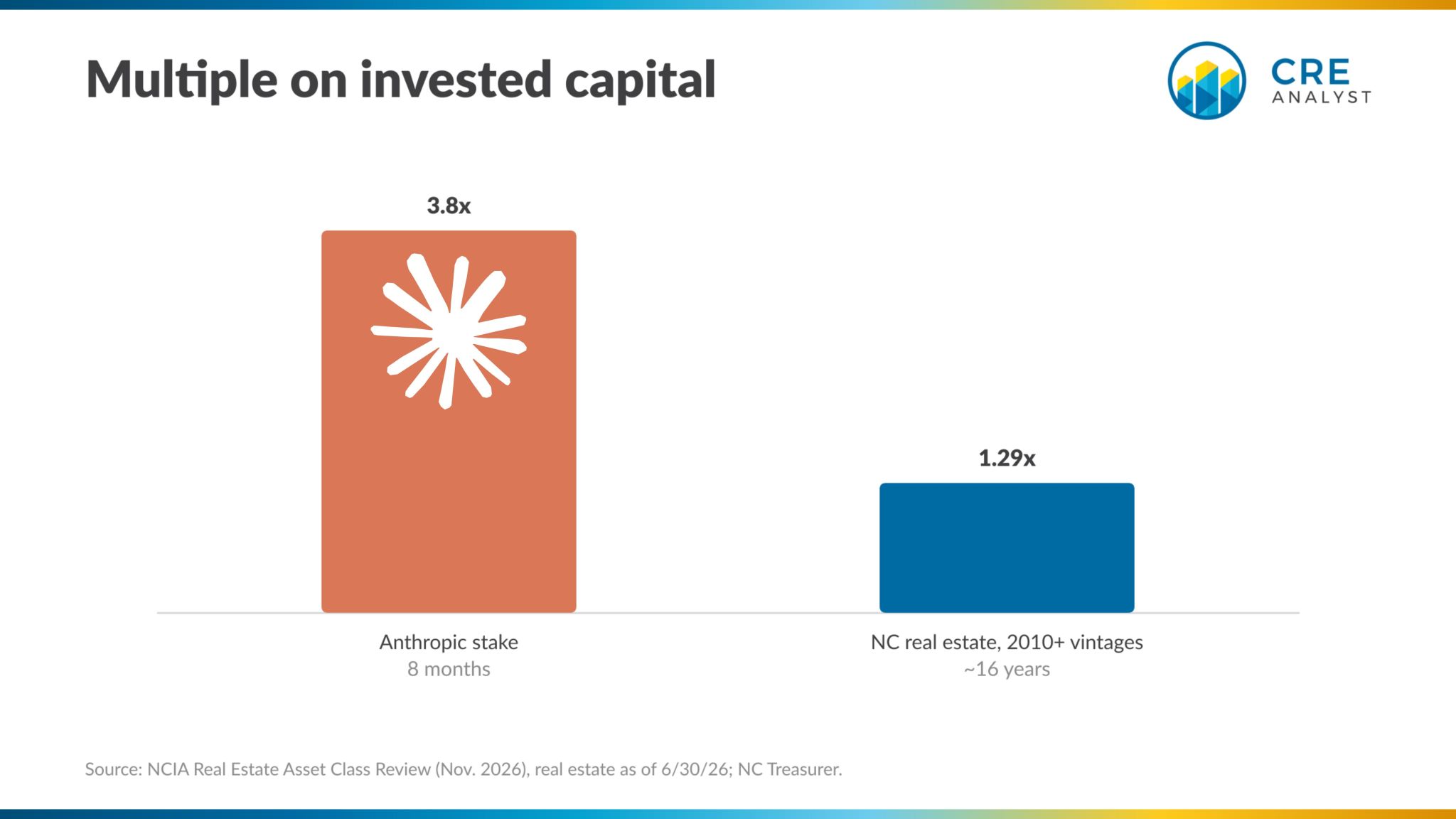
"That'll leave a mark"
A paper gain bigger than a year and a half of profit from NC's $9B real estate portfolio. ...from one $250M check signed eight months ago.
North Carolina's pension put $250M into Anthropic in March. With Anthropic now public, NC says the stake is worth $950M.
----- The math -----
The Anthropic investment:
$250M → $950M = 3.8x in 8 months
NC's real estate portfolio since 2010:
Current value: $8.8B
Distributions: $1.2B
Est. value in 2010: $3.0B
Net profit: ~$7.0B
1.3x, 7.35% net IRR
That's estimated net profit over ~16.5 years (!), which equates to about $425M a year.*
$700M / $425M = ~20 months of real estate's average annual profit
Apples to oranges, no doubt. The $700M is on paper. NC can't sell tomorrow.
But 20 months of profit on a $9B portfolio from a $250M investment is seismic.
----- Different jobs -----
The Anthropic investment was sized right; a miss is a rounding error, while a hit moves the whole plan. Amazing when it works.
Real estate plays a different role, which NC explicitly states in its real estate review:
-- income (4-6% cash yield)
-- inflation hedging
-- growth
-- diversification
-- optionality
The real estate portfolio has had a rough stretch. Office was 30% of the book in 2020. The 5-year return: -0.40% a year. But the 15-year return is 6.42% a year, ahead of its benchmark.
...which gets back to the traditional role of real estate in institutional portfolios.
----- The twist -----
NC is diversifying across asset classes while concentrating within real estate. The review describes a shift from a broad diversification mandate to a "flexible rifle shot approach."
Fewer, bigger bets in sectors they like: active adult, outdoor storage, necessity retail, funded in part by $3.2B parked in REITs while they line up deals.
----- Households vs. institutions -----
For most individuals and families, their house is the biggest basket they own.
For most small real estate investors, their bets are yield hunting.
For NC, real estate is ~8% of the plan.
Households buy to live in.
Small investors invest to pick up a few hundred bps.
But institutions buy to fill a role in a portfolio, on a pacing plan, against a benchmark and a liability.
And institutions often set the price.
Understanding what drives the biggest pools of capital allows for following dollars through the system, which leads to better decision-making, whether you're buying, lending, building, or job hunting.
* Excludes the REIT staging portfolio funded in 2026. Sources: NCIA Real Estate Asset Class Review (Nov 18, 2026); Carolina Journal (2009 value).
PS -- Kudos to North Carolina Department of State Treasurer. Huge win for North Carolina taxpayers and public pensioners.
COMMENTS