
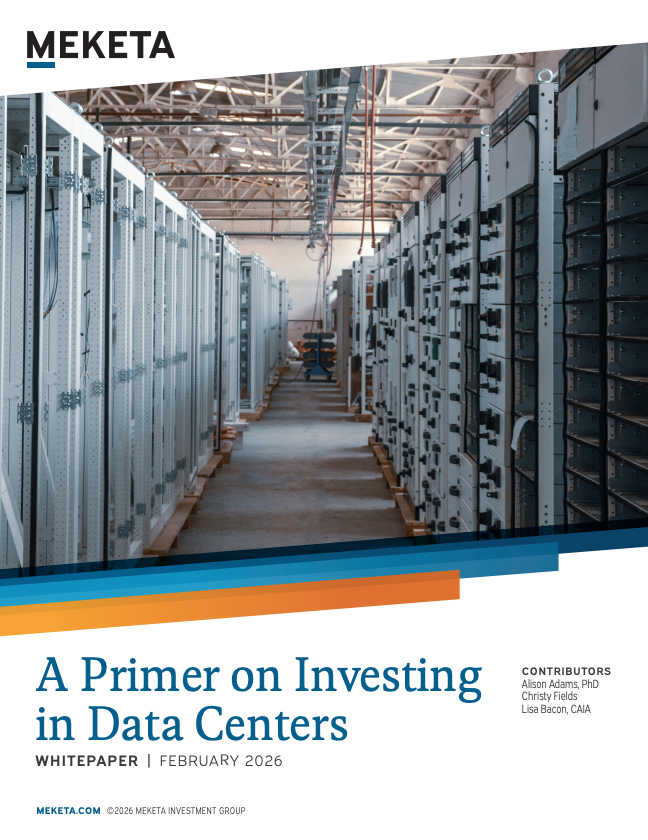
Are data centers the new railroads?
(And is that good or bad?)
5 ways to invest…
The big 5 hyperscalers will put $450B into AI infrastructure this year.
Relative to GDP, that's on par with the entire US railroad boom.
And since CRE follows capital, real estate players want a piece of the $.
But a data center doesn't sell square footage. It sells megawatts. Reliable, deliverable power is the product.
So is it real estate? ...ish. ...maybe.
----- 1. Public REITs -----
Most accessible entry.
Equinix and Digital Realty are the dominant names.
Goods: Liquidity, transparency, instant diversification.
Bads: But these perpetual vehicles are very sensitive to interest rates, and stock prices can remain disconnected from fundamentals for years.
----- 2. Private real estate funds -----
Most large private managers have added data centers to diversified portfolios in recent years. Smoother reported returns, more direct exposure.
Meketa's concern: "greater dispersion by manager/fund." That's a polite way of saying execution separates winners from losers, not demand. Preleasing rates in Northern Virginia and Dallas-Fort Worth are already above 75% through 2027. The bottleneck isn't tenants. It's whether the sponsor can actually deliver power on time.
----- 3. Private infrastructure funds -----
Infra managers underwrite data centers the way they underwrite toll roads.
And they were doing it long before real estate folks started talking about megawatts.
----- 4. Dedicated digital infrastructure funds -----
A newer vehicle class. Managers focused exclusively on data centers, fiber, towers, and spectrum. Higher concentration risk, but deeper operator expertise and a cleaner mandate.
Goods: focused and skilled
Bad: no hedge
----- 5. Debt and structured financing -----
Some of the most attractive risk-adjusted exposure over the last few years came from lending into data center development rather than owning the equity.
High capital intensity plus power uncertainty plus long lead times creates real demand for construction and bridge capital. First-loss stays with the equity. Lenders sit higher in the stack. In a sector where terminal values are genuinely hard to underwrite, that positioning isn't nothing.
But a bad loan or two could upend these economics.
----- The railroad analogy cuts both ways -----
Railroads transformed the American economy. They also produced one of the great capital destruction events in US financial history: overcapacity, rate wars, waves of bankruptcies.
None of that means data centers are a bad investment. It means the demand tailwind doesn't guarantee asset-level returns.
COMMENTS